This story will be a cumulative effort between Richard Tumin and Melissa Murphy in remembering a series of conversations that took place in and around Siem Reap from the 17th to the 21st of July, 2016.
It is important to note though, before I start writing, that while these stories might seem far-fetched to those in the Western World, that there are many parallels between what I will write and stories in the Judeo-Christian tradition. I am in no way writing these stories to cause discomfort or make fun of anyone, I just feel like they are worth preserving. Before you judge them, take a long and hard look at stories in your own religious tradition and see that there are many similarities.
Without further warnings and tangents, here is the story as best as we can both remember.
In the immediate vicinity to Angkor Thom is a pool that is about 20 meters by 20 meters. The pool is covered with lotus, and despite having an outward look of being the typical half bog, half rainwater collection pond, it holds a mystical secret.
You might know you are in the right area when you both see the pool fitting these dimensions, are in Angkor Thom park, and notice that you suddenly have absolutely no cell phone reception.
Our story starts with the idea of Eternal Beings. To quickly define these beings is to state that they might living to be 200-1000 years of age, and if they do "die" they rise again a few days later looking different and moving on to other places. Much like the idea of immortality, they are beings who have achieved this status by their good works and deeds.
To cite a few more numbers, there are precisely seven of these beings in Cambodia. They range in age, but our source was quick to say that his grandparents were two of them, and had reached quite an old age to say the least. Our sources grandparents had been around since the beginning, seen the rise and fall of dynasties, watched colonizers and wars come and go, and managed to just evolve with the times.
Cambodia and most of Southeast Asia is an interesting mix of mysticism and old religions. The ideas of spirits, vengeful hexing, eternal beings, and other such notions is not something on the fringe of society like it might be in the United States, but something that is very real and very easily explained. Our source is someone who is highly intelligent, and lives in a society with a very complex social structure, that has thousands of years of mystic tradition.
Ask a person in Thailand if they want to go to Cambodia or Laos, and they will immediately question your sanity - there are ghosts up there. It is not speculation, it is fact.
Ask a Cambodian and they will agree, the land is alive with spirits.
Our source, with grandparents older than modern civilization proceeded to tell us about the Royal Sword of Cambodia, is hidden very neatly in Angkor Thom; a complex with hidden catacombs of precious metals (which was confirmed by many sources that we talked to).
Our story should not start with the making of the sword, nor why it was hidden under the water in that 400 square meter pool, but with the colonization by the French, the subsequent atrocities caused by the United States Army, the following era of death brought about by the international community and the Khmer Rouge, becoming a Viet Nam puppet state, and finally to the modern era.
In our story the French are the first aggressors, they were the first modern tourists to Angkor Wat and Thom, and like all colonial tourism, they decided that anything that was worth stealing needed to be ferreted back to France. Gold bullion, precious gems, and other such bounties of conquest left Angkor Wat and Thom, and slowly the glory of the area faded but the worldwide knowledge grew.
Our source starts his story just have this time period. The complex was looted, the world was aligning against any form of communism - real or imagined.
The United States had started its very own secret war inside Cambodia, working to cut off the supply lines to Viet Nam. Sadly, cutting off these supply lines meant dropping more bombs on rural Cambodia than the United States had used in all of the Second World War. Many people died, many were maimed, almost nothing was achieved besides driving Cambodia deeply into communist hands and causing every person who lived to fear the bombing sorties done by three B-52s flying in a triangle formation.
It might be fair to say that this is the start of the Cambodian Genocide. This was their tipping point. Without the unfathomable and quasi-secret destruction the us wrought upon Cambodia, the Khmer Rouge would have never rose to power. Of course that is a story for another time though.
The Royal Sword of Cambodia though has the power to destroy weapons and save the people who truly believe and pray to it for protection. Our source said that as a child, and later a child soldier that he was immune to bullets and bombs (and many times showed various amounts of skin to prove said fact) because of the power of the Sword.
The way the Royal Sword works is that it has a soul or a spirit per-say, and that is what protects the person. The idea of the Sword is what protects you. The speed in which the protection can reach you is unfathomably fast, and should the Sword know you are worthy, then it will grant protection to you. Much like other forms of insurance, we were told that we could be grandfathered into the protection because our source was also protected.
He said that he spent many nights running from exploding American bombs, mostly likely through minefields, and later spent many days and nights ferrying grenades to either his father who was paramilitary, or to his mother who was on a different side of the conflict. Needless to say, either parent was never happy that the child was working for the other person on the other side. Like any child soldier - he had no choice and was just a tool in a much larger and greater war.
The sword continued to protect him throughout the massive genocide that swept the nation, the moving of the Khmer Rouge power structure to the border area near his home, mine fields, the massive death toll from later disease and famine, and pretty much every other atrocity that humans can sling at one-another. Still the sword and his grandparents, two of said Eternal Beings, lived on.
The sword has not been seen since the time of the french occupation, but can still be felt and be used for protection through the spirit that resides inside of it to this day.
He says that it rests under the dirt at the bottom of the 20 meter by 20 meter pool, where weapons cannot harm a person and cell phones do not work.
After he was done with the story, I asked him if he was going to become an Eternal being, or if he was one already. He answered that he honestly did not know - that he lived his life trying to be as good as possible, to make up for any pain he had caused, etc. While his parents died during the disease time in and around the reign of the Khmer Rouge, his grandparents still continue to travel around Cambodia, sleeping at various temples, being hosted by monks, and being keenly aware that they are much, much older than any of the other people around them - save only the five other eternal beings.
Saturday, August 6, 2016

Saturday, July 30, 2016
Angkor Wat, Angkor Thom, Siem Reap, and the Surrounding Area
Cambodia is a very difficult place to write about for quite a few reasons, not the least of which is the underlying scar that is the very recent genocide. Everyone, and I mean literally every-single-person was impacted by the genocide that killed between 1/4 and 1/3 of the entire population of the country. Everyone you meet in Cambodia has a story, a family member that was killed, a parent lost to the era. There is a figurative shadow still on the land, just below the happy smiling surface of the people who live there - God only knows how they still go about their days.
The temples are beautiful, well beyond compare to anything that I have seen in the area, and the people are very friendly and kind, but when you start to peel back the layers on the surface, you begin to see the people who were most impacted by the war and the refuse of war that was left after the Khmer Rouge, Americans, and other rampaging despots finally left or were removed or otherwise deposed.
It is very common to see men, women, and even children shuffling around with less than four limbs, to see them resorting to begging with rubber slippers attached to the stumps of what used to be fully functional legs - until a landmine changed their life.
I thought I would start out the post with this and end it on a happier note. Not sure how it gets happier, but I will certainly try.
For those of us in the first-world, landmines are a thing that Hollywood makes up, and just shows cleanly killing someone.
They are designed to maim. They are not designed to kill a person, just render them wounded, and usually with a clear focus to take the legs off at the knee.
For most of the landmines in the war-torn regions of the world, where safety regulations are more of a suggestion, there are no records of where the mines are located.
I wish I could say that the US is leading the charge at making regions like this much safer, but we are not. We do give funding to organizations that remove landmines from places like Cambodia, but we also continue to manufacture landmines at an alarming rate.
While many lives and families have been destroyed by these weapons, there is a silver lining. Each year, less and less children are hurt from the mines still buried in the fields in and around villages. Marking said fields is getting easier, and with the stable political situation in Cambodia, more funding is able to help those who are hurt by leftover ordinance.
That being said, it is still estimated that there are between four and six million landmines in Cambodia. That is about one landmine for every 3-4 people in the country.
I realize that it is very dark to explain all of this before getting to the fluffy and beautiful photos that are Angkor Wat, Angkor Thom, and Siem Reap, but I really wanted to attempt to show the side of the country that a person might not see on Trip Advisor.
Cambodia is a very complex country, and one that should be enjoyed for the sheer beauty that dominates all of the landscape, but not one that should be romanticized. The war is still too fresh and real for almost every single Cambodian over the age of 30.




3. It is very hot. I have lived in Thailand for a year and I still almost melted. If you have not been to the tropics, you cannot imagine this level of heat. Sure, you might have gone to the desert or something during summer, but yeah, trust me, that is nothing.
4. Take a lot of newer $1 bills. Cambodians prefer US dollars to their own currency.
5. Sit down in the cool (temperature) temples that ring the Angkor Wat complex. There are never tourists there, and most of the Cambodians we met were more than happy to let us share the shade and just hang around their temples.
6. Show respect. Yes, there is a dress code, women must cover their shoulders and most of their legs. Deal with it. It is not your country and you should show some level of respect for their culture. I wanted to smack a lady who was arguing with a guard about the fact that she did not want to cover her shoulders when going to the top of Angkor Wat. Assholes like her are what gives everyone a bad name. Cambodians are people, with a very long history and very complex social order. Don't try and impose your way of life on them. They have had enough problems in the recent past, they don't need you to bring your own bullshit as well.
7. Realize that these are still active and working religious sites. Enjoy them for that reason. There are monks, show them respect. Don't touch them, but sit back and watch. Some of my favorite moments at the complex were not actually in the tourist areas, but sitting with a group of Cambodians in a shrine way off in the forest watching them have a religious ceremony. Just take your shoes off, smile and go sit way in the back - it will be obvious if you are not wanted, but I would almost guarantee that you will be welcomed with a smile and a gesture to sit.
Cambodia is making amazing strides towards whatever healing can be done from such a horrible recent history. We loved it there. It was amazing to say the least. I can honestly say that I feel both touched and in awe of the complex and vibrant culture that is Cambodia.
The temples are beautiful, well beyond compare to anything that I have seen in the area, and the people are very friendly and kind, but when you start to peel back the layers on the surface, you begin to see the people who were most impacted by the war and the refuse of war that was left after the Khmer Rouge, Americans, and other rampaging despots finally left or were removed or otherwise deposed.
It is very common to see men, women, and even children shuffling around with less than four limbs, to see them resorting to begging with rubber slippers attached to the stumps of what used to be fully functional legs - until a landmine changed their life.
I thought I would start out the post with this and end it on a happier note. Not sure how it gets happier, but I will certainly try.
For those of us in the first-world, landmines are a thing that Hollywood makes up, and just shows cleanly killing someone.
They are designed to maim. They are not designed to kill a person, just render them wounded, and usually with a clear focus to take the legs off at the knee.
For most of the landmines in the war-torn regions of the world, where safety regulations are more of a suggestion, there are no records of where the mines are located.
I wish I could say that the US is leading the charge at making regions like this much safer, but we are not. We do give funding to organizations that remove landmines from places like Cambodia, but we also continue to manufacture landmines at an alarming rate.
While many lives and families have been destroyed by these weapons, there is a silver lining. Each year, less and less children are hurt from the mines still buried in the fields in and around villages. Marking said fields is getting easier, and with the stable political situation in Cambodia, more funding is able to help those who are hurt by leftover ordinance.
That being said, it is still estimated that there are between four and six million landmines in Cambodia. That is about one landmine for every 3-4 people in the country.
I realize that it is very dark to explain all of this before getting to the fluffy and beautiful photos that are Angkor Wat, Angkor Thom, and Siem Reap, but I really wanted to attempt to show the side of the country that a person might not see on Trip Advisor.
Cambodia is a very complex country, and one that should be enjoyed for the sheer beauty that dominates all of the landscape, but not one that should be romanticized. The war is still too fresh and real for almost every single Cambodian over the age of 30.


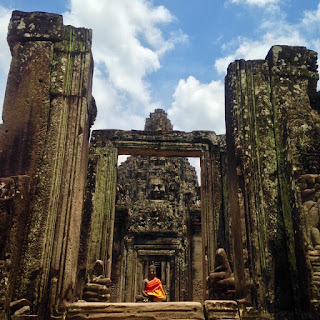
Angkor Wat and Angkor Thom are beautiful, and besides the MANY scam artists there, they are beyond comparison. They truly are a wonder of the world. Depending on the time of day, the complex is either devoid of tourists or crawling with people, with most of the tourists coming for sunrise and then bailing until the afternoon. My friend and I had almost the whole complex to ourselves at times when we would just try and miss these peak hours.
Pieces of advice for Angkor Wat and Angkor Thom:
1. Tuk Tuks should be no more than a few dollars.
2. EVERYONE will try and scam you. Period. This could be little kids selling things, or "university students" giving tours. 3. It is very hot. I have lived in Thailand for a year and I still almost melted. If you have not been to the tropics, you cannot imagine this level of heat. Sure, you might have gone to the desert or something during summer, but yeah, trust me, that is nothing.
4. Take a lot of newer $1 bills. Cambodians prefer US dollars to their own currency.
5. Sit down in the cool (temperature) temples that ring the Angkor Wat complex. There are never tourists there, and most of the Cambodians we met were more than happy to let us share the shade and just hang around their temples.
6. Show respect. Yes, there is a dress code, women must cover their shoulders and most of their legs. Deal with it. It is not your country and you should show some level of respect for their culture. I wanted to smack a lady who was arguing with a guard about the fact that she did not want to cover her shoulders when going to the top of Angkor Wat. Assholes like her are what gives everyone a bad name. Cambodians are people, with a very long history and very complex social order. Don't try and impose your way of life on them. They have had enough problems in the recent past, they don't need you to bring your own bullshit as well.
7. Realize that these are still active and working religious sites. Enjoy them for that reason. There are monks, show them respect. Don't touch them, but sit back and watch. Some of my favorite moments at the complex were not actually in the tourist areas, but sitting with a group of Cambodians in a shrine way off in the forest watching them have a religious ceremony. Just take your shoes off, smile and go sit way in the back - it will be obvious if you are not wanted, but I would almost guarantee that you will be welcomed with a smile and a gesture to sit.
Cambodia is making amazing strides towards whatever healing can be done from such a horrible recent history. We loved it there. It was amazing to say the least. I can honestly say that I feel both touched and in awe of the complex and vibrant culture that is Cambodia.
Saturday, July 16, 2016
The Killing Fields of Cambodia
I wish I knew the words that could express the deep feeling that exists from the horrific events of the Khmer Rouge and Pol Pot. When it comes to the Killing Fields and the S21 Prison in and around Phnom Penh, Cambodia, I feel that it might just be best to let the photos speak for themselves.
I usually try to lay off the heavy subjects on this blog. There is enough sadness and horror in the world and I am not one that wants to glorify or perpetuate it. The images below can and will be difficult; just a quick word of warning.
I learned a few things today.
1. The audio tour at both places will cause you to fight back tears for hours straight. Period.
2. You will see entire bones from human skeletons surfacing after rainstorms around the Killing Fields.
3. A semi-feral dog can be made into a therapy dog with enough coaxing and squeezing.
The first stop of the day was the Killing Fields, located about 30 minutes down a somewhat bumpy road heading south of Phnom Penh.


I usually try to lay off the heavy subjects on this blog. There is enough sadness and horror in the world and I am not one that wants to glorify or perpetuate it. The images below can and will be difficult; just a quick word of warning.
I learned a few things today.
1. The audio tour at both places will cause you to fight back tears for hours straight. Period.
2. You will see entire bones from human skeletons surfacing after rainstorms around the Killing Fields.
3. A semi-feral dog can be made into a therapy dog with enough coaxing and squeezing.
The first stop of the day was the Killing Fields, located about 30 minutes down a somewhat bumpy road heading south of Phnom Penh.
The site is quite unassuming at first. You walk in and see a massive stupa, and even though you know what is inside (skulls and bones of the victims of the Cambodian Genocide), but the area is clean and clear, with some chirping birds and a lot of ants on the ground. After picking up the audio tour, which has to be one of the best audio tours I have ever heard, you just... walk. The tour guides you slowly into the nightmare that was 1975-1979 Cambodia.
By nightmare, I mean something beyond that. One out of every four Cambodians died during this time.
I wish I knew how to explain what I saw, but honestly I am emotionally drained.
I did not know that bones still surfaced at the mass grave sites.
I did not know how full pants and shirts from the people who were murdered still washed up in huge amounts.
I did not know that a tree was expressly used for killing children, or that the sugar palm fronds were used to cut throats.
There were a lot of things that I did not know, nor would I have ever known. I might wish that I still was unaware of these atrocities, but I am also grateful that I can share in the collective knowledge of the events. I was in a similar mood after visiting Nagasaki, Japan, and I feel that way now. I feel some guilt for not being aware of these events on a more intimate level. I feel a massive amount of sadness for the people who had their lives unjustly taken from them in some of the most horrific ways imaginable. I feel anger that more people are not aware of these events and their personal impact.
Everyone has heard of Pol Pot and the Khmer Rouge, but seeing how this country still reels from the horrors that faced it about 40 years ago, just bring it to a light that I never knew was possible. Children now play with dogs near the places where their families were executed a generation prior. School goes on as normal mere meters away from a detention and torture center that still has barbed wire on it and odd stains on the floors and walls.
It says a lot about healing, it says a lot about the resilience of humanity, and it says a lot about the need to remember these events.
Without further feeble attempts of explaining facts that I was horrifically unaware of a mere 12 hours ago, I will stop talking and let the photos speak for themselves.

Recently surfaced bones before final interring in the central stupa

Clothing surfacing after a rainstorm from a mass grave

The central stupa holding the remains of the victims of the area

Barbed wire covering the breezeway at the S21 prison

Barbed wire around the prison, much like the day it was liberated.

A bone surfacing after the recent storms

The entrance of one of the cell blocks from the S21 prison

Skulls in the central stupa.

My semi feral therapy dog

The top of the structure marking where the trucks would leave people for execution

Skulls of the victims, market by nationality and cause of death.

Surfaced pants that had been moved off the ground

Holes punched through walls in the S21 to allow for the guards to watch more prisoners

Ribbons, candy, and toys left on the tree where babies were executed by blunt trauma.
The idea was that to "remove the grass, you also need to pull the roots."
The accusation and extermination of one family member meant the whole family would die.

Death caused by hacking with a hoe or machete

The fence at S21 prison

A skeleton, still waiting to be fully exhumed

Depressions in the soil from the decomposition and exhumation of human remains

A bone, possibly a femur, that has not been picked up yet by park docents to be cleaned and interned. The rainy season has just started in Cambodia

The old and new meet in Cambodia. A view from inside the torture chambers of the S21 prison towards central Phnom Penh. The barbed wire and death of the past frames the skyscrapers of the modern era. The two eras only missed each other by 40 years.

The central stupa housing human remains

Skulls and bones are stacked as high as the eye can see

Villagers burning prayer offerings for the children who were killed

A beautiful day almost masks the depressions in the earth where many people lost their lives

People killed by blunt force trauma

A gnarled tree near the point where people would be taken from the trucks and bludgeoned or cut to death

Clothes and unknown objects surfacing after the the rain

Skulls have a colored dot and a small number on them marking nationality and cause of death as determined by a team of forensic scientists.
A side note: To people who are unfamiliar with South East Asia might find the display of human body parts as being insulting to the memory of these victims, but they are put on display with extreme reverence and it is done in part to "help their souls find peace in the next life"
I guess the simplest way to think of it would be to say, that it is better to remember their lives and use that knowledge to ensure events like this do not happen again.
Friday, July 15, 2016
Kuala Lumpur, Malaysia - Take Two!
I am not going to lie, I have a very clear and favorable bias towards Malaysia. I find the culture inspiring, the food beyond delicious, and the people to be some of the nicest that I have interacted with in any country.
I decided to bring my friend to Malaysia, just so that she could experience the culture and food of one of my favorite places. I am quite glad that I did. My second time here was just as pleasant as the first, and my trip was far more quirky.
While I had a few things planned, for the most part the name of the game was to eat as much Indian and Malaysian food that our bodies could handle.
We decided after landing that we would make our way via the train to Batu Cave (mostly to see the monkeys hassle tourists). Honestly, Batu Cave is very pretty, but the best part of it is watching packs of monkeys attack the unaware tourists and steal their things. Not going to lie, I had far more fun doing that than anything else that day.


I decided to bring my friend to Malaysia, just so that she could experience the culture and food of one of my favorite places. I am quite glad that I did. My second time here was just as pleasant as the first, and my trip was far more quirky.
While I had a few things planned, for the most part the name of the game was to eat as much Indian and Malaysian food that our bodies could handle.
We decided after landing that we would make our way via the train to Batu Cave (mostly to see the monkeys hassle tourists). Honestly, Batu Cave is very pretty, but the best part of it is watching packs of monkeys attack the unaware tourists and steal their things. Not going to lie, I had far more fun doing that than anything else that day.


We decided on day two to meet up with an old friend, which turned into lunch at a wonderful Indian restaurant, then on to an aquarium, and finally to see the stand-up comedy in which said friend was taking part.
Needless to say, the day was quite long, but we both agreed that it was one of the best memories of the trip.
Lunch was great.
The aquarium was very interesting - especially getting to watch them feed the piranha.


This lady might have the only "feeding frenzy selfie" in existence...
I saw her setting up for this photo, making sure all the angles were right, and I knew I needed to roast her via my very limited exposure blog. Just... yeah...
The above video is in case you ever wanted to see a school of piranha devour a dead fish at the Aquaria KLCC. I know that is on so many bucket lists - you can thank me later.
The comedy show though took the cake, I was so much better that we even expected in our wildest dreams. To put this in perspective, I am usually asleep by about 10pm. I like my sleep, and I HATE staying up late. I was up until 2am that night, laughing so hard I thought I was going to have a seizure.
My friend Prakash was the emcee for the evening, so I really only took videos of him when he was on stage because he has also been a friend of Danielle's for about ten years, but honestly, the stand up performances were comedy gold.
If you are ever in Kuala Lumpur, make sure to check out 1 Mic Stand. Trust me, best choice you can make in Malaysia.

After my rather late but quite enjoyable night, we took a pretty lazy day the next day. We set out to locate some desired souvenirs at a local market, and then made an attempt to go up KL tower. Needless to say, the cost was damn near insane, and we did not go up. Instead we decided that we had enough luck for one day, and geared up for our last full day in KL, which we decided would be featuring a visit to the KL Bird Park.


We also threw in a quick trip to the National Mosque of Malaysia, and met up with a great guide there who had actually been to Hawaii, and did an amazingly great job explaining modern Malaysian Islam, the architecture of the National Mosque, and answered a lot of questions in a very neutral way.


Now, when visiting mosques, it is always best to dress conservatively. My friend and I chose to wear clothing that would be both covering and non-offensive in nature. Part of being a good traveller is knowing the local area and dressing as best as you can to blend and not offend. In places like Malaysia, that does sometime mean wearing head coverings for women, and not wearing shorts that we might consider more fitting for the ultra-hot region.
Also, drug references are usually bad, along with skin-tight short dresses.

This photo is taken near the entrance to the national mosque. Pretty sure the girl in the sleeveless, bra-showing, skin tight, very short, pot leaf dress did not get the memo...
I am very much not into shaming someone for their choice in clothing or body-type, but there is fashionable, and there is stupid. This lady is just stupid. I really did stand there for a few minutes and thought to myself, "was there any part of her that wondered if she ought to pick a different outfit to visit an Islamic Mosque?"
Oh well...
So, on to the KL Bird Park.
I am not a fan of big birds, small birds, flying birds, etc. They have beady eyes that always look like they are contemplating taking their beaks and using them to violently bring about the end of mankind.
KL bird park is quite cool though. It is acres of open-air sections that just have different birds... everywhere. Honestly, it would be very cool to not only bring a kid or a school group on a field trip, but just to wander around and take photos. You could easily spend a day here, but could rush through it as well in about an hour and a half


We left just as the skies were about to open up again and pour on us, so we took shelter in a museum that SHOULD NOT BE MISSED UNDER ANY CIRCUMSTANCES while in Malaysia.
I love museums.
I love museums that have been curated well.
I love well organized museums that have cataloging numbers.
I could go on and on about my OCD about great museums.
This museum met all of my OCD needs and then some. I was beautiful, there was an amazing mixture of Malaysian and Islamic history. The displays were wonderfully done, the artifacts were impeccably cared for, and the historical narrative was in a very neutral tone.
If you find yourself in Kuala Lumpur, spend the time and the small amount of Ringit and visit the Islamic Arts Museum.


Another amazing trip to Malaysia, and I honestly look forward to the next one. Seriously, this has to be one of my favorite countries.
Subscribe to:
Posts (Atom)